

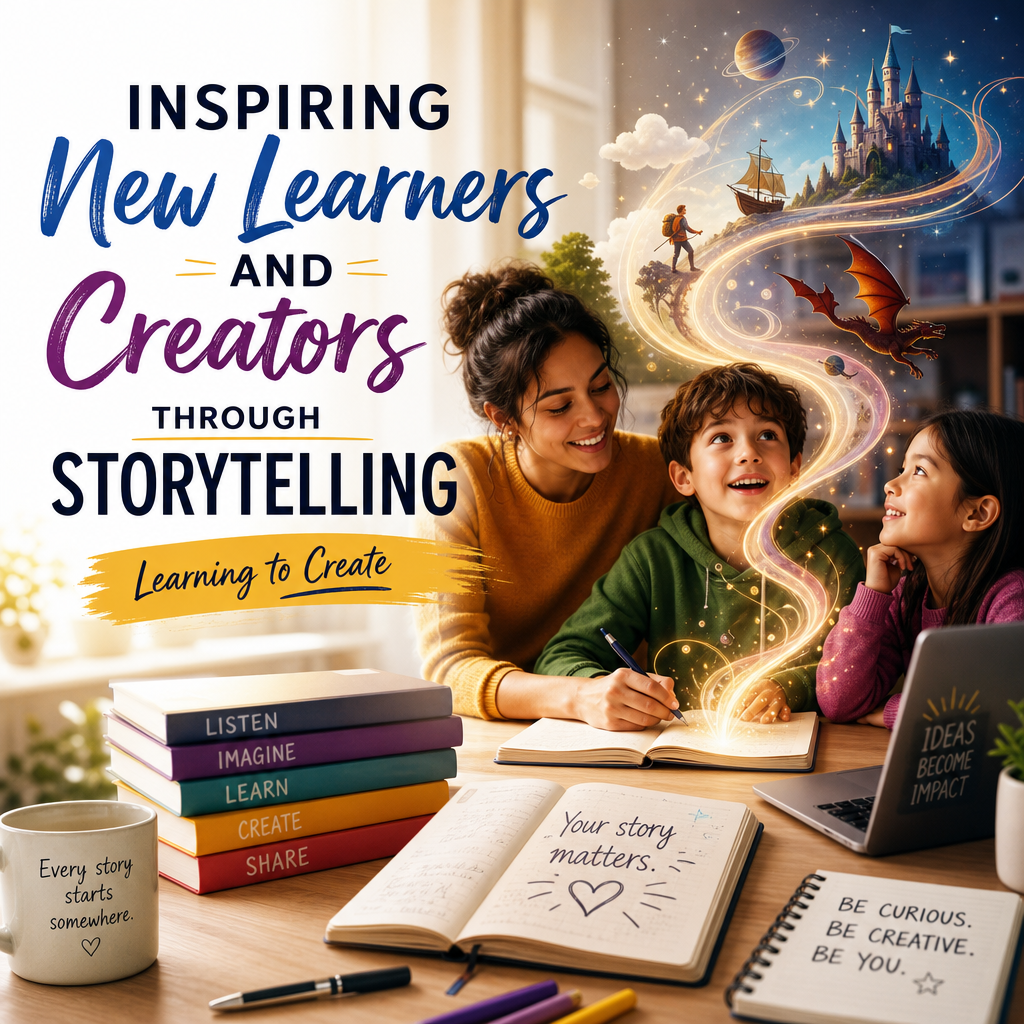
Inspiring New Learners and Creators Through Storytelling
The First Small Step
Maya almost didn’t start.
She had a notebook full of ideas, a desk covered in half-finished sketches, and a head crowded with doubts. She wanted to learn how to create something meaningful—something that would make people feel, think, or smile—but every time she opened a blank page, she felt the same familiar weight: What if I’m not good enough yet?

That question followed her everywhere.
It followed her when she tried to write her first short story and deleted the opening paragraph seven times. It followed her when she watched other people post polished work online. It followed her when she told herself she needed to know more, practice more, be more before she could begin.

Then one evening, while the rain tapped gently against her window, Maya made a decision.
She stopped waiting to feel ready.
Learning Starts Before Confidence
Maya didn’t suddenly become fearless. She simply decided that fear did not need to be the end of the story.
She opened her notebook and wrote one sentence. Then another. They were awkward. Some were too simple. Some sounded clumsy. But they were hers.
That was the moment she began to understand something important: learning is not a doorway you walk through only after you become skilled. Learning is the path itself. You stumble, notice, adjust, and keep going.
For new learners and creators, this is often the hardest truth to accept. We want certainty before effort. We want talent before practice. We want results before risk.
But growth usually begins in the messy middle.
What Helps in the Beginning
When everything feels unfamiliar, small habits can make the process less overwhelming:
- Start tiny. One paragraph, one sketch, one idea.
- Repeat often. Progress comes from returning, not from perfection.
- Keep a record. Save drafts, notes, and rough attempts to see how far you’ve come.
- Ask better questions. Instead of “Am I good?” try “What did I learn today?”
- Let beginner work be beginner work. It is supposed to be unfinished.
Maya began keeping a “first draft” folder. At first, it felt like a graveyard of imperfect attempts. Later, it became proof that she was moving.
The Power of Making Something Real
One afternoon, Maya shared a short story with a friend. It wasn’t polished, but it had a heartbeat. Her friend read it, smiled, and said, “I could picture that whole scene.”
Maya was surprised. She had been focused on everything she thought was wrong with the story, but someone else had found a moment that worked.
That is one of the quiet miracles of creating: what feels small to you can still matter deeply to someone else.
A sketch can become a memory. A paragraph can become comfort. A simple idea can spark another person’s courage. When you make something real, you give your inner world a place to exist outside of you.
And that matters.
Because learning is not only about collecting information. It is also about expression. It is about turning curiosity into form.
Creativity Grows in Practice
Over time, Maya noticed that inspiration arrived more often when she was already working.
She used to wait for perfect ideas. Now she understood that ideas often appear while moving your hands, typing a sentence, or trying a new technique. The act of creating invites the next idea forward.
This is true for many kinds of learners:
- A beginner painter learns by mixing colors that don’t quite match.
- A new writer learns by hearing the rhythm of awkward sentences.
- A future programmer learns by debugging one line at a time.
- A musician learns by playing notes that sound wrong before they sound right.
Skill is not built in a single leap. It is built through repetition, curiosity, and patience.
When You Feel Stuck
Everyone gets stuck sometimes. When that happens, Maya found it helpful to:
- Go smaller — reduce the task to the easiest possible next step.
- Change the form — write, sketch, speak, or outline instead of forcing one method.
- Borrow inspiration — read, listen, observe, and notice what others do well.
- Rest without quitting — stepping away can be part of the process.
- Return with kindness — self-criticism rarely creates good work.
Progress does not always look dramatic. Sometimes it looks like returning after a pause.
The Story You Are Already Writing
Months later, Maya looked back at her first draft and laughed a little. It was rough, yes. But it had become the beginning of a larger body of work she never could have imagined on that rainy night.
She had not become a different person. She had become a more practiced one.
That is encouraging news for every new learner and creator. You do not need to wait for a version of yourself that has no doubts, no gaps, and no awkward first attempts. You only need the next small step.
The page, the canvas, the instrument, the lesson—they are all waiting for your attention, not your perfection.
Begin Before You Feel Ready
If you are standing at the edge of something new, let this be your reminder: starting small is not a weakness. It is wisdom.
Every expert was once a beginner. Every finished piece began as a rough draft. Every confident creator was once someone who had to learn how to begin.
So write the first line. Draw the first shape. Try the first lesson. Share the first idea.
Your story as a learner and creator is already unfolding, and the most important chapter is often the one where you simply decide to begin.