
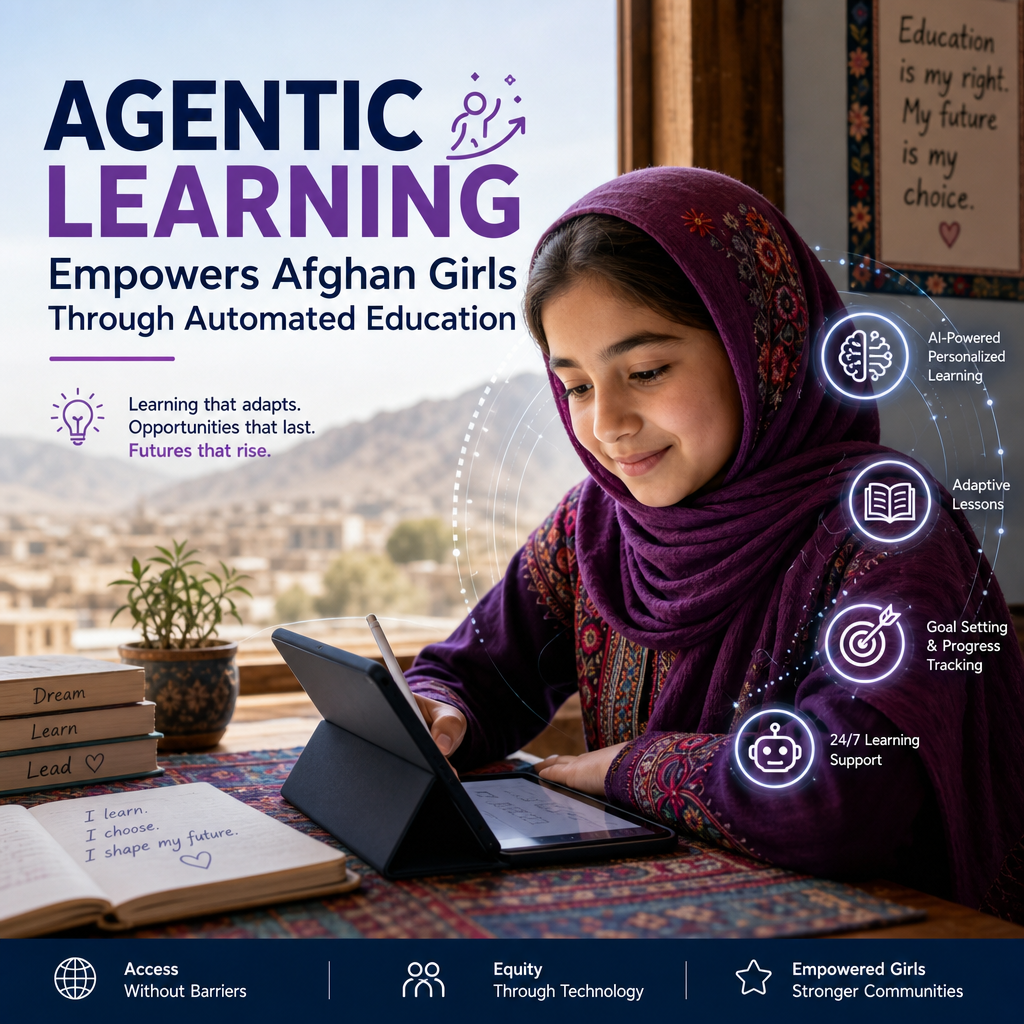
Agentic Learning Empowers Afghan Girls Through Automated Education
The Rise of Agentic Learning: Empowering Afghan Girls Through Automated Education
Education has always been a pathway to opportunity, independence, and resilience. For many Afghan girls, however, that pathway has been repeatedly blocked by conflict, displacement, poverty, and restrictions on access to formal schooling. In this difficult landscape, agentic learning is emerging as a powerful idea: a model of education that gives learners more control, personalization, and access through automated tools.
Agentic learning does not replace teachers or human support. Instead, it uses technology to help students learn more actively and independently. For Afghan girls, this approach can be life-changing. It can offer lessons beyond classroom walls, adapt to different learning levels, and create educational continuity even when schools are unavailable.

What Is Agentic Learning?
Agentic learning is an approach where students take a more active role in shaping their education. Rather than passively receiving information, learners can set goals, receive personalized guidance, and move through content at their own pace.
In automated education systems, this often includes:

- Adaptive learning platforms
- AI-powered tutors
- Mobile learning apps
- Automated assessments and feedback
- Offline or low-bandwidth digital lessons
The key idea is simple: education should respond to the learner, not force every learner into the same rigid system.
Why Afghan Girls Need New Learning Models
Afghan girls face some of the world’s most severe barriers to education. These barriers include:
- School closures and restrictions
- Safety concerns during travel
- Shortages of female teachers
- Poverty and early marriage pressures
- Limited internet and device access
In many communities, these obstacles are not temporary. They can interrupt schooling for years at a time. When a girl cannot attend school consistently, she often falls behind and may never return.
This is where agentic learning matters. Automated education can help preserve learning opportunities when traditional systems fail. A girl with a phone, a shared tablet, or even a basic offline device may still be able to study reading, math, science, and digital skills.
How Automated Education Can Help
Automated education uses technology to deliver lessons, track progress, and provide feedback with minimal manual intervention. For Afghan girls, this can open doors that would otherwise remain closed.
Personalized pacing
Every learner is different. Some girls may need more time with basic literacy, while others are ready for advanced math or language study. Automated systems can adjust content based on performance, allowing students to progress at their own pace.
Learning anywhere
A classroom is not always available, but learning can still continue. Mobile-friendly platforms, downloadable lessons, and audio-based education tools make it possible to study at home or in community spaces.
Immediate feedback
When a student answers a question incorrectly, automated tools can provide instant explanations and try again with easier steps. This keeps learning active and reduces frustration.
Privacy and confidence
Some girls may feel shy or unsafe in group settings. Digital learning platforms can offer a private space to practice skills, make mistakes, and build confidence without fear of judgment.
The Role of Community and Design
Technology alone is not enough. For agentic learning to truly help Afghan girls, it must be designed with local realities in mind.
That means:
- Content in local languages
- Offline access for low-connectivity areas
- Low-cost or shared devices
- Cultural sensitivity in lesson materials
- Support from families and community leaders
A strong system should also include human encouragement. Mentors, volunteer tutors, and local education workers can help girls stay motivated and solve problems that technology cannot address alone.
Challenges That Must Be Solved
The rise of agentic learning is promising, but it is not a complete solution. Serious challenges remain.
Digital access gaps
Many families do not have reliable internet, electricity, or devices. Without infrastructure, automated education cannot reach everyone.
Gender inequality
Girls may be given less access to phones or digital tools than boys. This makes equitable design and community engagement essential.
Safety and monitoring
Online education platforms must protect learners’ privacy and avoid exposing them to harmful content or surveillance risks.
Quality of content
Lessons must be accurate, relevant, and aligned with educational standards. Poorly designed content can do more harm than good.
A Future Built on Learning Autonomy
Despite these challenges, the potential of agentic learning is real. It offers a way to move from dependency on fragile institutions toward learning systems that are flexible, adaptive, and resilient. For Afghan girls, this means more than convenience. It means the chance to keep learning even when circumstances are unstable.
Automated education cannot solve every social or political problem, but it can preserve hope. It can help girls continue their studies, build skills, and imagine futures beyond the limits placed on them.
Conclusion
The rise of agentic learning signals a major shift in how education can be delivered to those who need it most. For Afghan girls, it offers a practical and hopeful model: one that blends technology, autonomy, and accessibility.
When designed responsibly, automated education can become more than a digital tool. It can become a bridge to opportunity, a source of dignity, and a quiet but powerful form of empowerment.