
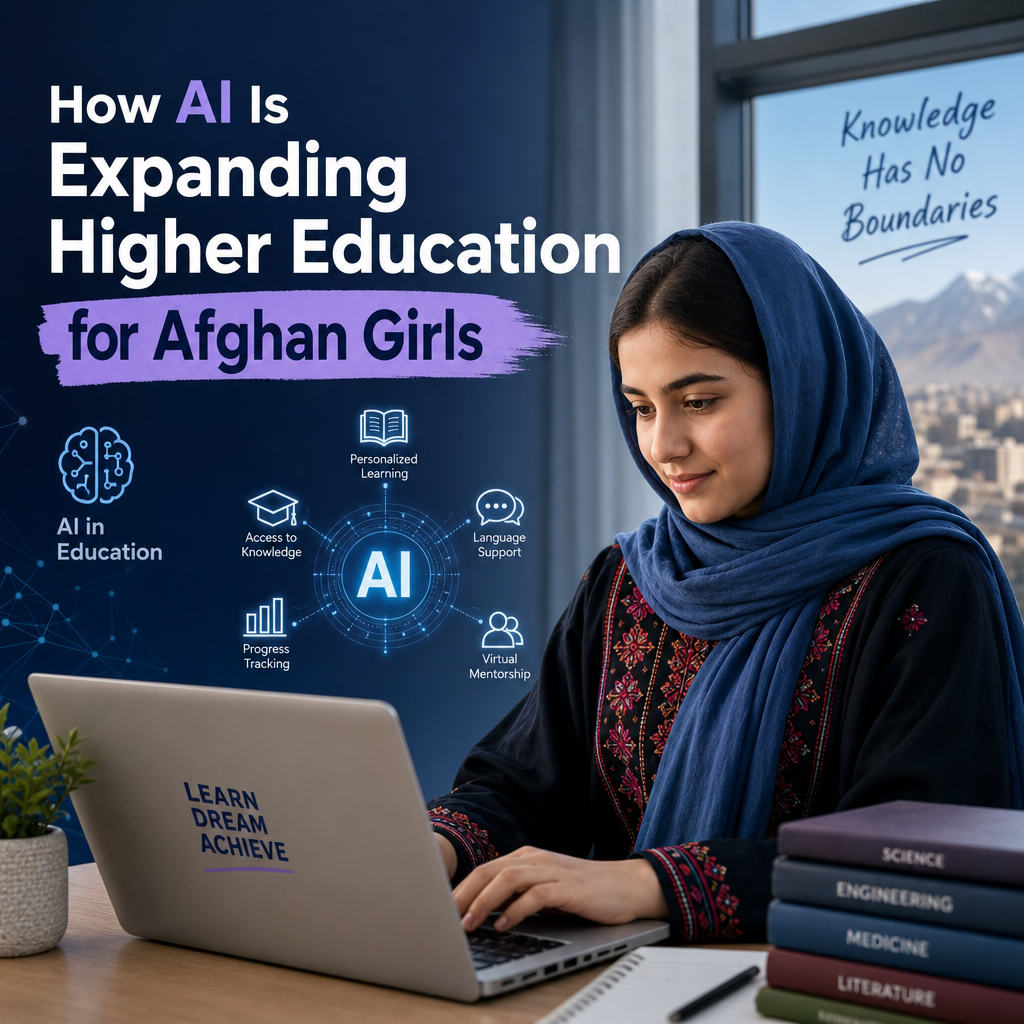
How AI Is Expanding Higher Education for Afghan Girls
How AI Is Opening New Doors for Afghan Girls in Higher Education
For many Afghan girls, the path to higher education has long been shaped by barriers that are difficult to imagine from the outside. Distance, security concerns, limited school access, and social restrictions have all made learning harder. Yet technology is changing what is possible. How AI Is Opening New Doors for Afghan Girls in Higher Education is not just a headline; it is becoming a real story of resilience, access, and hope.
Artificial intelligence cannot solve every challenge. But it can remove some of the biggest obstacles that keep girls from continuing their studies. From online tutoring to translation tools, AI is helping create learning opportunities that are more flexible, more affordable, and more accessible than traditional systems alone.

A New Kind of Classroom
One of the most important ways AI is helping Afghan girls is by making education available beyond physical classrooms. When schools or universities are out of reach, AI-powered learning platforms can bring lessons directly to a phone or computer.
These tools can:

- offer lessons at any time of day
- adapt to a student’s pace
- provide instant feedback on quizzes and assignments
- recommend additional practice based on weak areas
This matters greatly for girls who may need to study from home, share devices with family members, or balance education with household responsibilities. AI makes learning more flexible, which can be the difference between continuing education and giving up entirely.
Breaking Language Barriers
Language is another major challenge in higher education. Many Afghan students are fluent in Dari or Pashto, but a lot of online academic material is in English. AI translation tools are helping bridge that gap.
Today, AI can:
Translate learning materials quickly
Textbooks, lectures, and academic articles can be translated into more familiar languages, helping students understand complex subjects more easily.
Support English learning
AI language apps can help students practice reading, writing, speaking, and listening. This is especially valuable for girls hoping to apply to international scholarships or study programs.
Improve comprehension
Even when translations are imperfect, AI can still make material more accessible by simplifying difficult language and explaining unfamiliar terms.
For Afghan girls aiming to enter universities, language support is more than a convenience. It is a gateway to global knowledge and academic opportunity.
Personalized Learning at Scale
In a traditional classroom, teachers often do not have enough time to give each student individual attention. AI can help fill that gap. Adaptive learning systems track progress and adjust lessons to match each student’s needs.
For Afghan girls, this kind of personalization can be transformative. A student who struggles with mathematics can receive extra practice. Another who learns quickly can move ahead without waiting. AI does not replace teachers, but it can extend their support.
This is especially useful in places where teacher shortages are common or where girls have limited access to qualified instructors. Personalized AI tools can help keep motivation high and reduce the frustration that often leads students to drop out.
Expanding Access to Scholarships and Guidance
Higher education is not only about classroom learning. Many students also need help finding scholarships, preparing applications, and understanding admission requirements. AI can simplify these steps.
For example, AI tools can:
- search for scholarship opportunities
- help draft application essays
- check grammar and clarity
- explain university requirements
- prepare students for interviews
This kind of assistance can be invaluable for Afghan girls who may not have access to college counselors or mentors. A well-designed AI assistant can offer guidance that might otherwise be unavailable.
Learning Despite Limited Resources
In many parts of Afghanistan, internet access is unreliable and devices are limited. AI works best when paired with practical support, such as low-bandwidth apps, offline learning tools, and shared community access points. Even so, it can still create real value.
Short audio lessons, downloadable study packs, and mobile-friendly platforms make it easier for students to learn under difficult conditions. AI can also help compress large amounts of information into manageable chunks, which is ideal when data is expensive or time is short.
The key is not to imagine AI as a luxury. For many girls, it is becoming a practical learning companion.
Hope, Agency, and Future Careers
Education is about more than degrees. It is about confidence, independence, and the ability to shape a future. AI is helping Afghan girls build those skills, even when circumstances are uncertain.
By using AI tools, students can:
- explore science, technology, engineering, and math subjects
- build digital literacy
- develop writing and communication skills
- prepare for remote work and online careers
These skills are increasingly important in a world where many jobs are digital. For Afghan girls, gaining access to higher education through AI may also mean access to future income, stronger community roles, and greater personal freedom.
A Tool, Not a Solution
It is important to be realistic. AI is not a replacement for safe schools, supportive families, or fair access to education. It cannot erase discrimination or political restrictions on its own. But it can help keep learning alive when other systems are under strain.
Used responsibly, AI can support teachers, empower students, and expand educational access in ways that would have been impossible just a few years ago. It can help Afghan girls continue learning, prepare for university, and connect with the wider world.
The Bigger Picture
The story of How AI Is Opening New Doors for Afghan Girls in Higher Education is ultimately a story about possibility. Technology alone does not guarantee progress, but it can create space for progress to happen. Every translated lesson, every personalized study plan, and every scholarship search completed by an AI tool is a small step toward a larger future.
For Afghan girls who want to learn, dream, and lead, AI is becoming more than a digital tool. It is becoming a bridge to opportunity.