
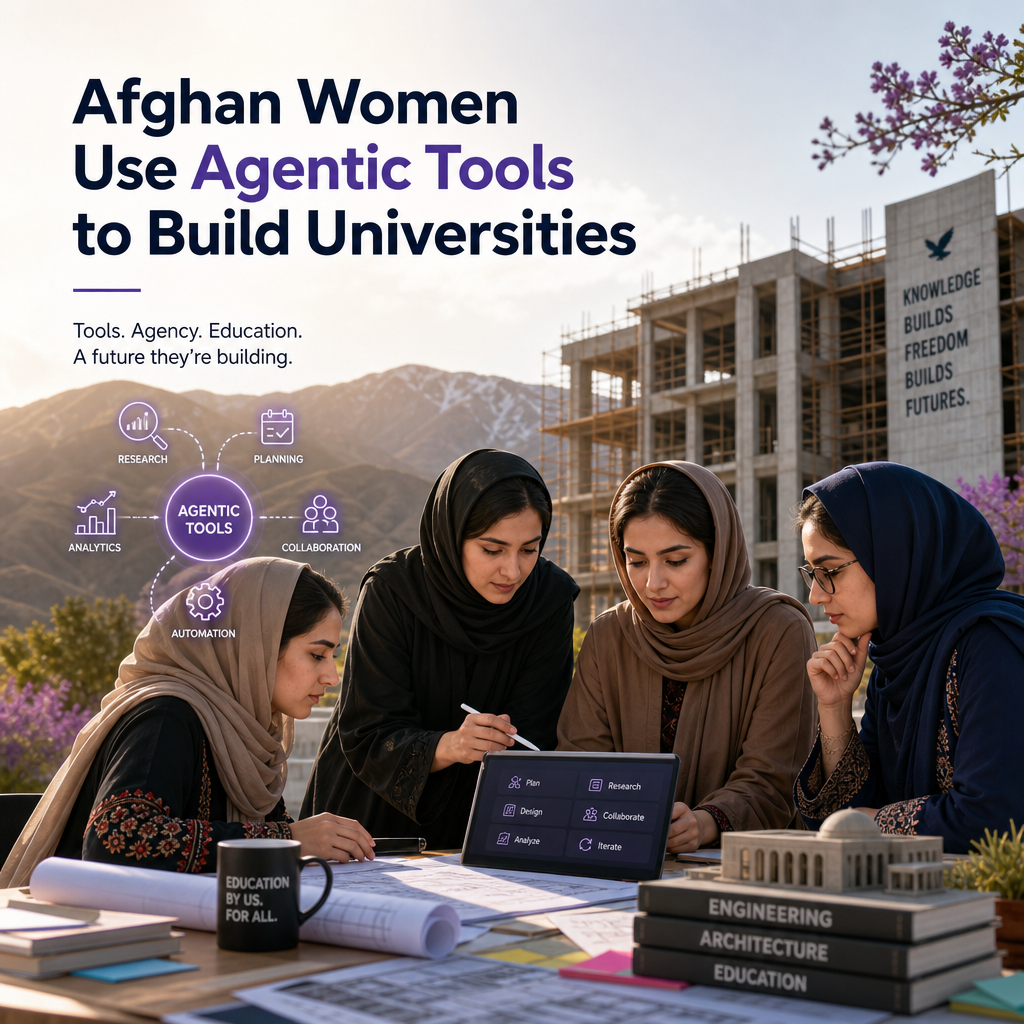
Afghan Women Use Agentic Tools to Build Universities
How Afghan Women Use Agentic Tools to Build Universities Without Technical Skills
Across Afghanistan, women are finding new ways to create opportunities in education, even when access to formal resources is limited. One of the most promising shifts is the rise of agentic tools—AI-powered systems that can plan, draft, organize, and automate tasks with minimal human input. These tools are helping Afghan women turn ideas into real educational projects, including online learning platforms, course catalogs, student support systems, and even the foundations of digital universities.
What makes this movement so powerful is simple: it does not require advanced coding or deep technical training. With the right prompts and workflows, women can use agentic tools to build something that once would have needed a full development team.

What Are Agentic Tools?
Agentic tools are AI systems that do more than answer questions. They can take a goal, break it into steps, and carry out parts of the work on their own. Instead of just generating text, they can help with planning, research, content creation, scheduling, and workflow automation.
For example, an agentic tool can:

- Outline a university website
- Draft course descriptions
- Organize admissions steps
- Create student onboarding checklists
- Translate content into multiple languages
- Suggest email responses for common questions
For Afghan women who may not have access to formal technical training, this matters a lot. These tools reduce the need to start from zero.
Why This Matters in Afghanistan
Education has long faced serious barriers in Afghanistan, especially for women. In many places, limited internet access, scarce funding, and restrictions on mobility make it difficult to build or attend traditional institutions. But digital tools have created a new path.
An online university model can lower some of those barriers by allowing women to:
- Learn from home
- Organize classes remotely
- Create flexible learning schedules
- Reach students across different provinces and communities
- Build educational projects with smaller teams
This is where agentic tools become especially useful. They allow women to move faster, work smarter, and do more with fewer resources.
How Afghan Women Are Using Agentic Tools
1. Designing the Structure of a University
Building a university starts with a blueprint. Agentic tools can help map out that blueprint by generating:
- Academic departments
- Degree or certificate tracks
- Student policies
- Enrollment steps
- Faculty role descriptions
A woman with a vision for a new learning institution can ask an AI agent to draft the first version of an organizational structure. From there, she can review, adjust, and improve it without needing to know how to code a backend system.
2. Creating Courses and Learning Materials
Course creation is one of the biggest tasks in education. Agentic tools can help generate:
- Lesson outlines
- Reading lists
- Quiz questions
- Assignment ideas
- Weekly learning plans
This is especially useful for women who are experts in a subject but not trained in instructional design. They can focus on the content and let the tool support the structure.
3. Building Websites and Digital Portals
Many agentic tools now connect with website builders and no-code platforms. That means Afghan women can create:
- Homepages
- Admissions pages
- Faculty bios
- Student portals
- FAQ sections
Instead of hiring developers, they can use AI to draft page content, propose page layouts, and guide site organization. The result is a functional online presence that can be launched much more quickly.
4. Managing Communication
Running a university requires constant communication. Agentic tools can assist with:
- Writing student announcements
- Drafting email templates
- Preparing responses to common questions
- Translating messages for wider audiences
- Creating social media updates
This helps small teams stay organized and present a professional image, even when they are working under pressure.
Why No Technical Skills Are Required
The biggest misconception about building a digital university is that it must be highly technical. In reality, many of today’s AI systems are designed for natural language use. That means a person can simply type what they want in plain English or another language and receive a useful result.
A user does not need to know:
- How to code a website
- How to build a database
- How to automate workflows manually
- How to write complex software instructions
Instead, the process is more like collaborating with a digital assistant. The user gives direction, the tool generates a starting point, and the user refines the output. This lowers the barrier to entry and opens the door for more women to lead educational innovation.
The Human Skills Still Matter Most
Although agentic tools are powerful, they are not a replacement for human leadership. Afghan women bring the most important skills of all: vision, resilience, cultural understanding, and commitment to education.
They know what their communities need. They understand which subjects matter, what students face, and how learning can be adapted to local realities. AI can support the work, but women are the ones shaping the mission.
That balance is what makes these projects meaningful. Technology does not decide the future of education by itself. People do.
A New Model for the Future
The idea that a university can be built without technical skills would have sounded impossible just a few years ago. Today, it is becoming more realistic. Afghan women are proving that with agentic tools, they can design systems, build learning platforms, and create pathways for education at a scale that was once out of reach.
This is more than a technology story. It is a story about access, creativity, and leadership. It shows that when tools become easier to use, more people can participate in building the future.
For Afghan women, that future may include something especially powerful: universities shaped by their own voices, built with their own ideas, and launched with the help of intelligent tools that make the impossible feel achievable.