
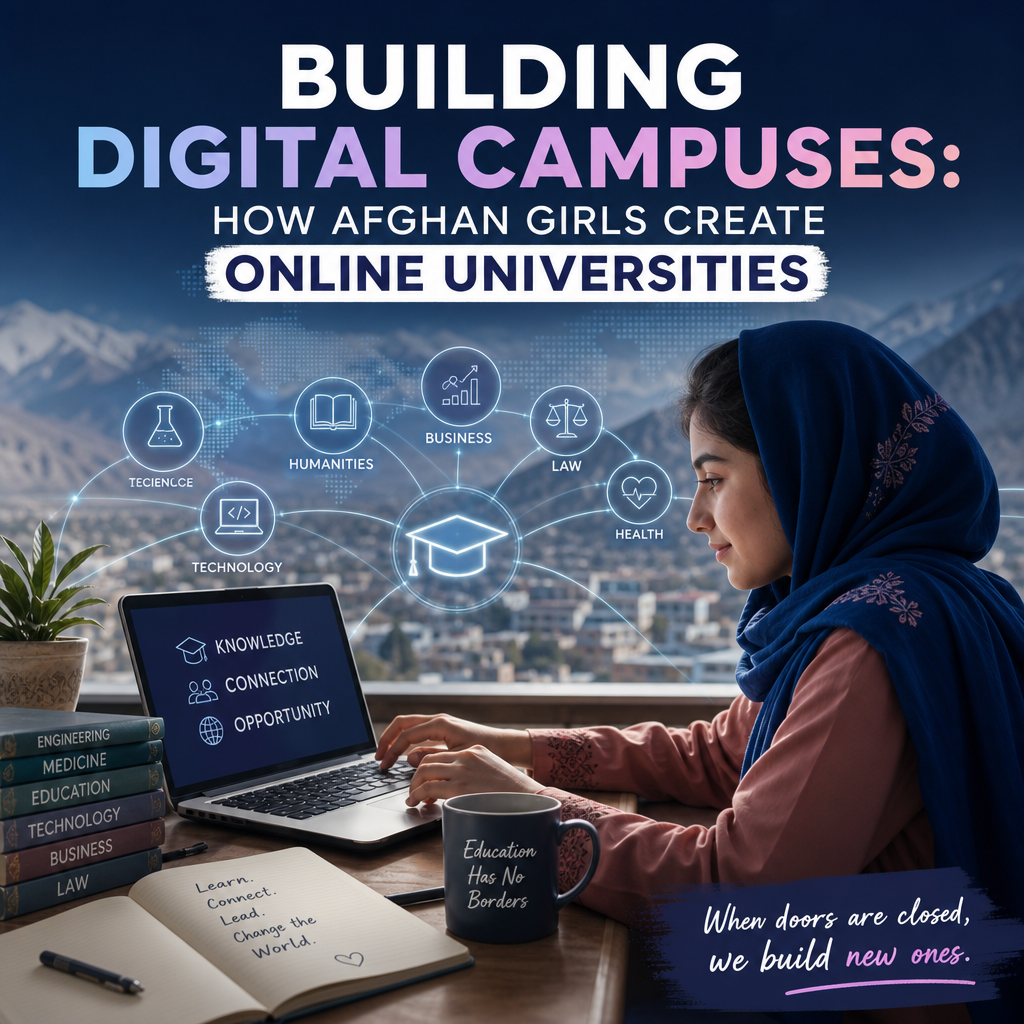
Building Digital Campuses: How Afghan Girls Create Online Universities
Building Digital Campuses: How Afghan Girls Create Their Own Online Universities
When classrooms close, learning does not have to stop. Across Afghanistan, many girls and young women have turned phones, laptops, and internet connections into tools of resistance and hope. In a country where education has been restricted and interrupted, they are building digital campuses—informal, flexible, and deeply determined spaces where knowledge can still grow.
These online communities are not official universities in the traditional sense. But for many Afghan girls, they function like one. They offer classes, discussion groups, mentorship, language practice, and access to subjects that were suddenly taken away. In doing so, they are redefining what higher education can look like under pressure.

A classroom with no walls
The idea of a university usually brings to mind lecture halls, libraries, and campus life. But for Afghan girls, education has increasingly moved into private chats, encrypted apps, social media groups, and video calls.
A digital campus can be as simple as:

- A weekly Zoom class on English or coding
- A Telegram group sharing study resources
- A WhatsApp circle for exam preparation
- A virtual reading club hosted by former teachers
- A peer-led course in journalism, business, or computer skills
These spaces are often built quietly and with limited resources. Yet they offer something powerful: continuity. They help students stay connected to learning, to one another, and to a future that still feels possible.
Why these online universities matter
For many Afghan girls, access to education is not just an academic issue. It is about identity, independence, and survival. Education once offered a path toward employment, self-confidence, and participation in society. When those doors were narrowed or shut, online learning became a lifeline.
Digital campuses matter because they:
-
Preserve learning momentum
Even short breaks from study can make it harder to return. Online classes help students keep moving forward. -
Create safe spaces
Many girls cannot travel freely to schools or universities. Remote learning offers a safer alternative. -
Build community
Isolation is one of the hardest parts of educational restrictions. Virtual groups create friendship, support, and accountability. -
Expand opportunity
Students can study languages, digital skills, and global subjects that may not be available locally. -
Support future careers
Online training in writing, design, coding, and entrepreneurship can help students earn income and build independence.
The women leading the way
One of the most inspiring parts of this movement is that many digital campuses are led by women who themselves were students, teachers, or university graduates before restrictions changed their lives. They understand both the loss and the urgency.
Some organize lessons from their homes. Others collaborate with international volunteers. A few create full course schedules, track attendance, assign readings, and hold discussions just like a formal university would. In many cases, they are building education systems from scratch.
This leadership is significant. It shows that Afghan girls are not only participating in learning—they are designing it. They are becoming educators, organizers, and mentors for the next generation.
Obstacles that remain
The growth of online education has not erased the difficulties. In many areas, internet access is unstable or expensive. Electricity is unreliable. Some families may not be able to afford devices. Privacy is also a concern, especially when girls must study in shared homes with little control over their environment.
There are also emotional costs. Studying online cannot fully replace the social and academic experience of a physical campus. The uncertainty can be exhausting. Many students worry about whether their efforts will be recognized or whether they will ever be able to use their education openly.
Still, these barriers have not stopped them.
A new model of education
What Afghan girls are building is more than a backup plan. It is a new model of education shaped by resilience, creativity, and mutual support. Their digital campuses are decentralized and adaptable. They can appear, disappear, and re-form depending on safety and access.
This model teaches an important lesson: education is not defined by buildings alone. It is defined by the desire to learn, the willingness to teach, and the courage to keep going when conditions are unfair.
In this sense, every online lesson is also an act of defiance. Every shared notebook, every recorded lecture, and every group study session says that Afghan girls still belong in classrooms—even if those classrooms now exist online.
Hope, rewritten in code and connection
The story of Afghan girls creating their own online universities is not just about technology. It is about agency. It is about young women refusing to let closed doors determine their futures.
They are building digital campuses where knowledge survives, where ambition is not erased, and where education continues in quieter but no less powerful forms. In a time of loss, they are proving that learning can still be collective, purposeful, and alive.
And perhaps most importantly, they are showing the world that when access is denied, determination can build a campus of its own.